Class 10 - Techniques III - Mediation
Agenda
The logic of mediation: what, why, when, how (30 minutes)
Application paper discussion (30 minutes)
Break
Replication presentation (15 minutes)
Skills corner - Class walkthrough in R (25 minutes)
General discussion (15 minutes)
The logic of mediation
What is mediation?
In all instances, mediational models advance an X -> M -> Y causal sequence, and seek to illustrate the mechanisms through which X and Y are related. (Mathieu and Taylor 2006)
What is mediation?
Nomological network view:
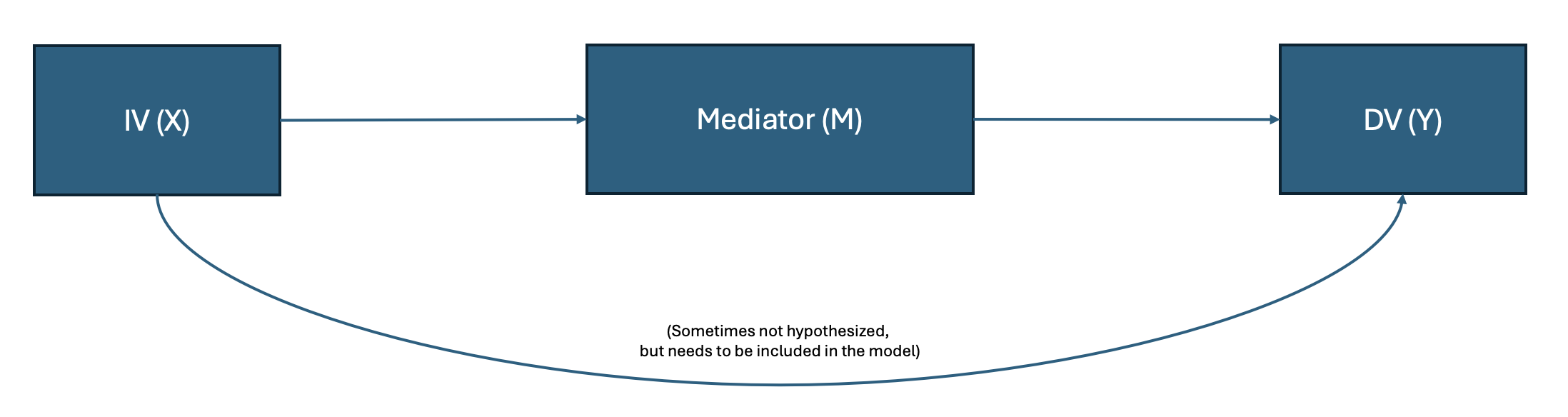 Regression model view:
\(Y = \beta_0 + \beta_1X + \beta_2M + \epsilon\)
\(M = \beta_3 + \beta_{4}X + \epsilon_M\)
Why mediation?
Provides direct evidence for a theoretical claim
“We submit that inferences of mediation are founded first and foremost in terms of theory, research design, and the construct validity of measures employed, and second in terms of statistical evidence of relationships.” (Mathieu and Taylor 2006, 1032)
Allows for assessment of causal effects via the front door criterion (Pearl 2001, 81)
Sophisticated tools allow for complex inferences
Establishment of direct and indirect effects for latent variables (Williams, Vandenberg, and Edwards 2009)
Partitioning of effects through multiple causal pathways
When is mediation appropriate?
Explaining “how” and showcasing mechanisms: \(Y = \beta_0 + \beta_1X + \beta_2M + \epsilon\)
Partitioning total and indirect effects: Comparing effect sizes between \(Y = \beta_0 + \beta_1X + \beta_2M + \epsilon\) and \(Y = \beta_0 + \beta_1X + \epsilon\)
Transmitting the influence of instruments: \(Innovation = \beta_0 + \beta_1(EquitySplits) + \beta_2(MembershipChange) + \epsilon\) ; \(MembershipChange = \beta_3 + \beta_4EquitySplit + \epsilon\)
Isolating mechanisms through interventions: \(Light On = \beta_0 + \beta_1Power + \beta_2(Switch=on) + \epsilon\)
Performing a mediation analysis
How do you perform a (basic) mediation analysis?
Articulate the theoretical justification for a mediational inference.
Clearly make your prediction as a hypothesis.
Run a sequence of regressions in line with your intended inference (Mathieu and Taylor 2006) and extract relevant effects
Perform statistical inference (t-tests, indirect effect tests)
Illustrate direct and indirect effects
Deep dive: Articulate your theoretical justification
In short, no statistical analysis can unequivocally differentiate one causal sequence from another. Theorists and researchers must then rely on other means to justify the sequence of effects. The most valuable bases to advance such inference come from: (1) experimental design features; (2) temporal precedence; and (3) theoretical rationales. (Mathieu and Taylor 2006, 1033)
Deep dive: Clearly make your prediction as a hypothesis
It is critical when making an argument for mediation that you specify what you mean. Following Mathieu and Taylor (2006), are you proposing:
A full mediation, where the mediating variable fully captures the effect of the IV on the DV?
A partial mediation, where the mediating variable captures, some but not all, of the effect?
An indirect effect, whereby the IV only has an effect on the DV through its influence on the mediator?
Illustrating a mediation: Indirect effects
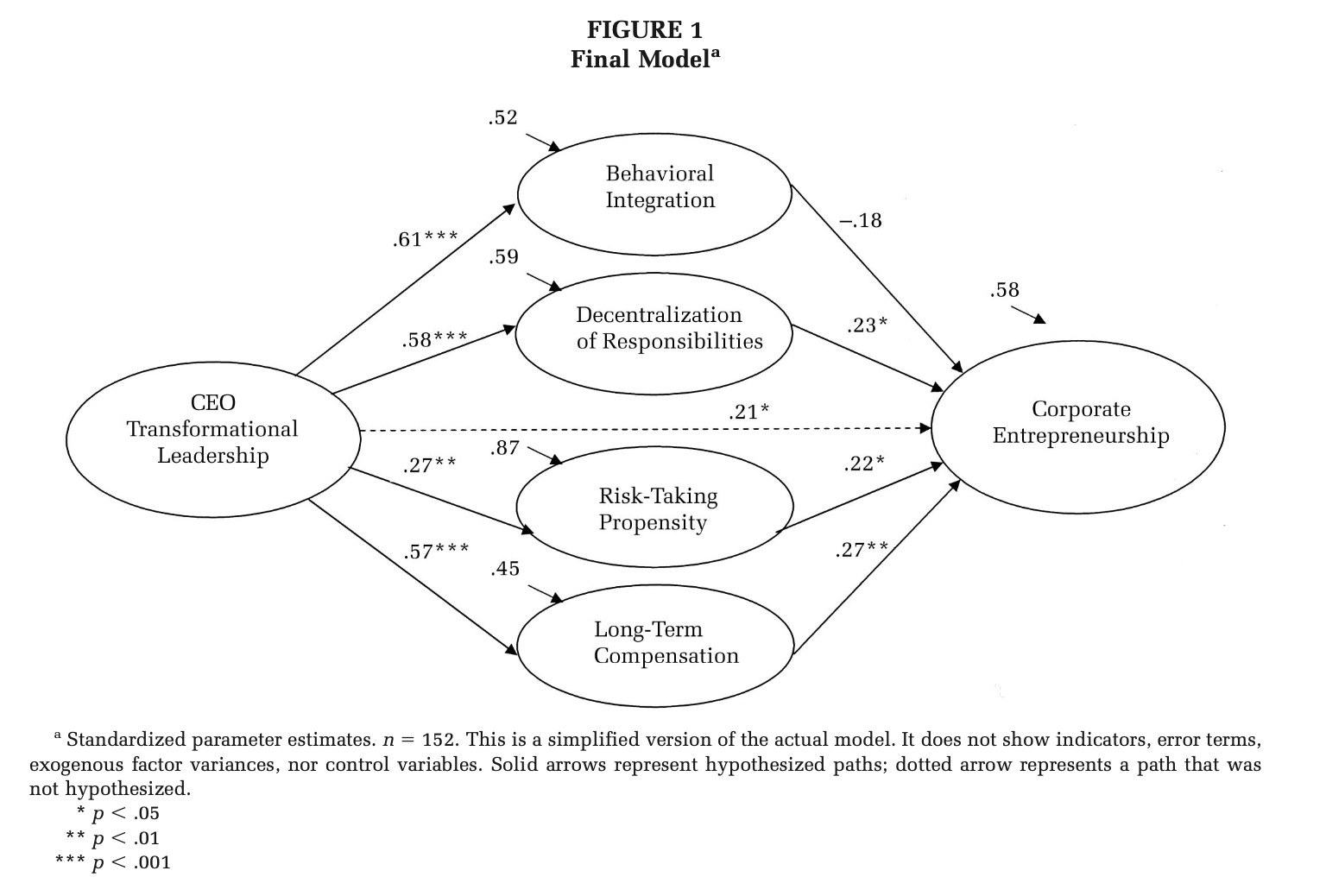
Things can get crazy (again)!
Multiple mediators (either in parallel (Ling et al. 2008) or in sequence)
As with complex moderation models, can you explain what you are doing?
“Generalizing” mediation: SEM
I have given you two readings (Williams, Vandenberg, and Edwards (2009) and Ling et al. (2008)) to help you dip your toes into the waters of structural equation model (SEM)
This is a fundamentally different way of looking at data, which seeks to compare an observed covariance matrix versus a “model implied” covariance matrix built from the relationships included or excluded from an SEM model (which can include a structural as well as a measurement model component)
The technique involves asking how many connections can be “pruned” without making the model fit worse - in other words, the more \(\beta_i = 0\), the better!
Alternative analyses
Structural equation modeling (Williams, Vandenberg, and Edwards (2009))
Non-linear causal models and Bayesian networks (Pearl (2001))
Applications
Application readings
Let’s level-set people’s familiarity with these pieces.
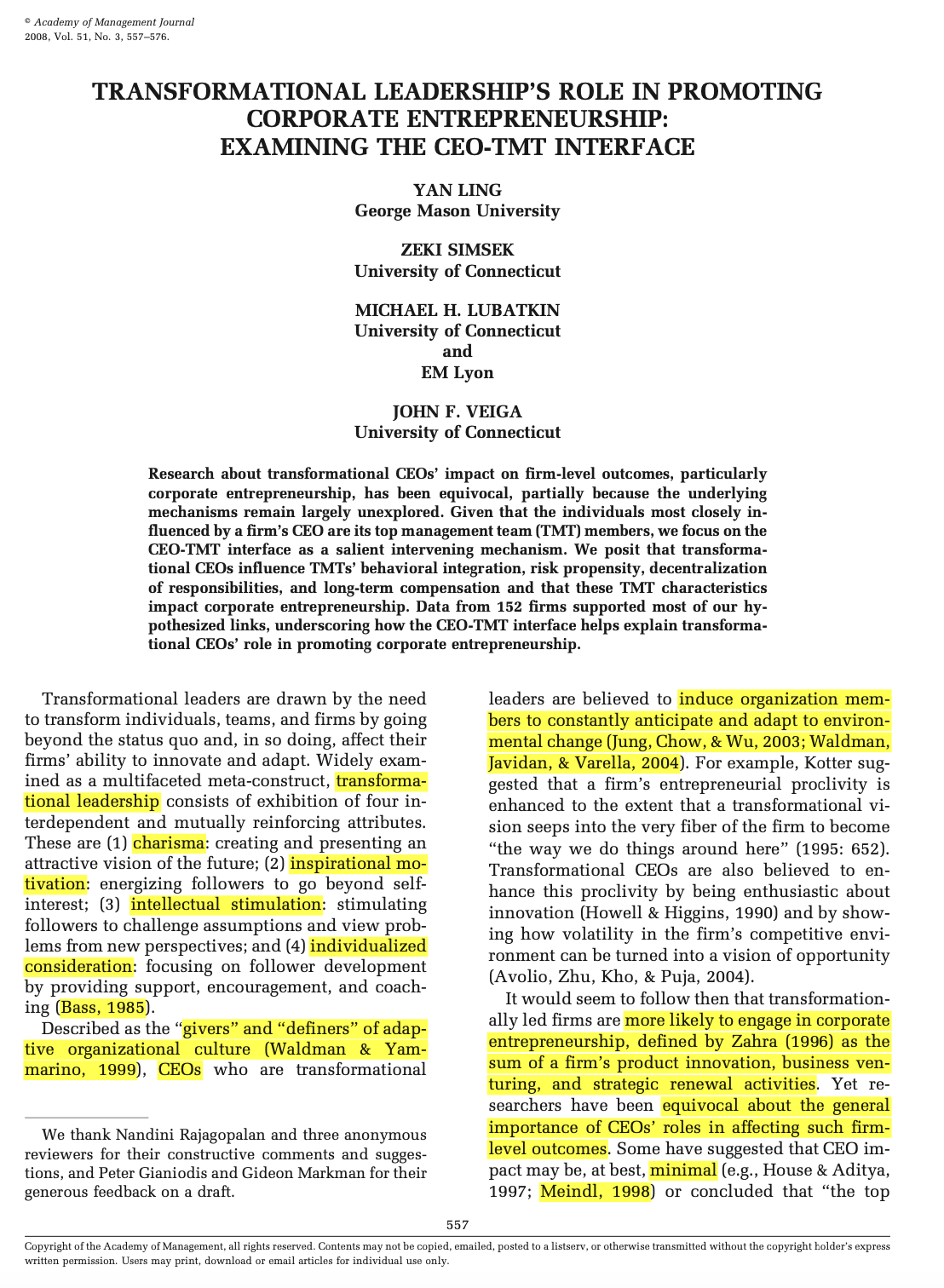
Ling, Y., Simsek, Z., Lubatkin, M. H., & Veiga, J. F. 2008. Transformational Leadership’s Role in Promoting Corporate Entrepreneurship: Examining the CEO-TMT Interface. Academy of Management Journal, 51(3), 557-576.
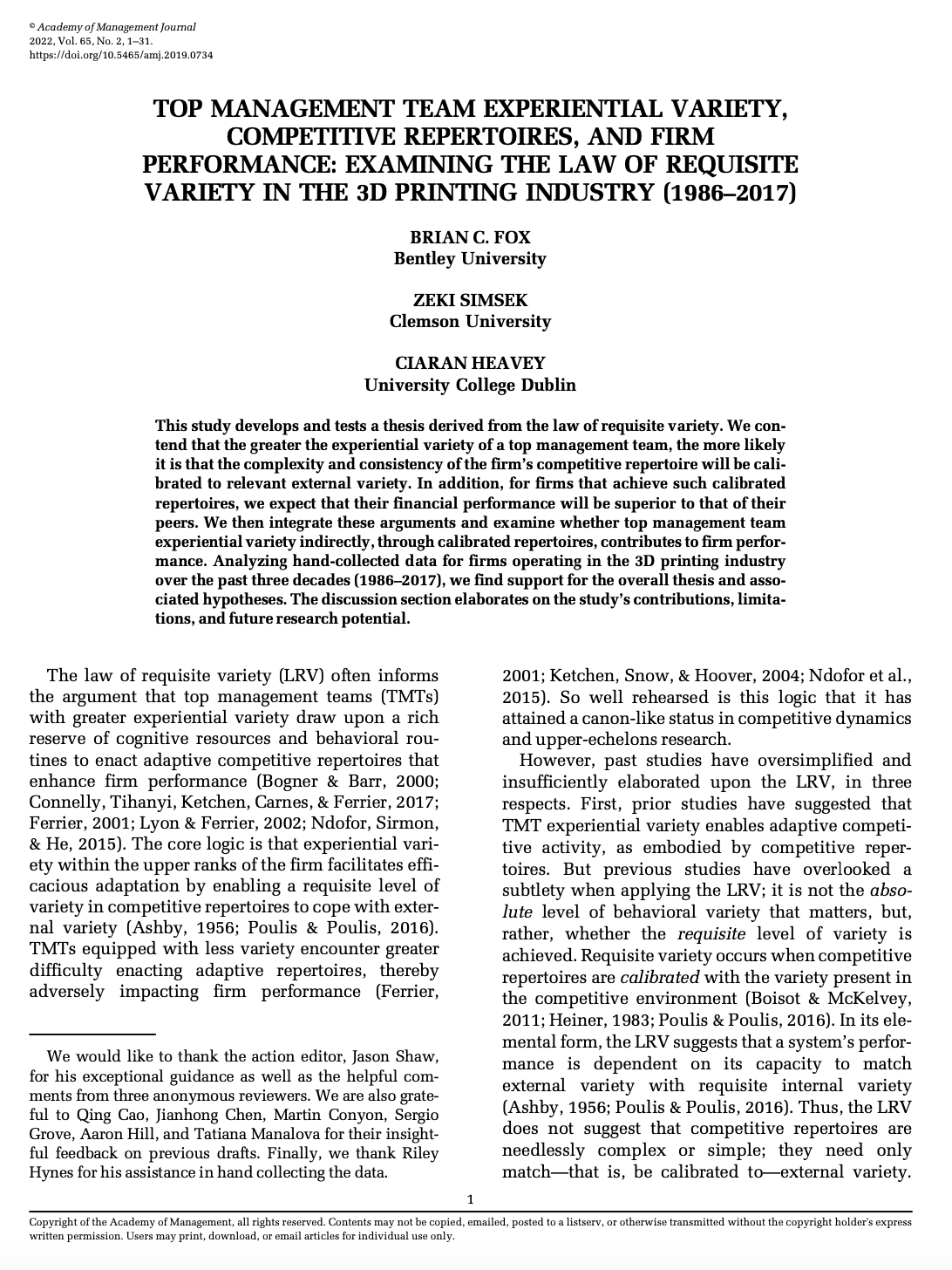
Fox, B. C., Simsek, Z., & Heavey, C. 2022. Top Management Team Experiential Variety, Competitive Repertoires, and Firm Performance: Examining the Law of Requisite Variety in the 3D Printing Industry (1986–2017). Academy of Management Journal, 65(2), 545-576.
Ling et al (2008)
What was this paper about?
What were the findings?
What was the method?
What makes sense? What was confusing?
Fox et al. (2022)
What was this paper about?
What were the findings?
What was the method?
What makes sense? What was confusing?
Break

Replication Presentation
- Replication: Fox, B. C., Simsek, Z., & Heavey, C. 2022. Top Management Team Experiential Variety, Competitive Repertoires, and Firm Performance: Examining the Law of Requisite Variety in the 3D Printing Industry (1986–2017). Academy of Management Journal, 65(2), 545-576.
Class Walkthrough in R
Preparation for next class
Next class
Techniques IV: Endogeneity
Cuervo-Cazurra, A., Andersson, U., Brannen, M. Y., Nielsen, B. B., & Reuber, R. A. 2016. From the Editors: Can I trust your findings? Ruling out alternative explanations in international business research. Journal of International Business Studies, 47(8), 881-897.
Hamilton, B. H., & Nickerson, J. A. 2003. Correcting for endogeneity in strategic management research. Strategic Organization, 1(1): 51-78.
Next class
Techniques IV: Endogeneity
Applications:
Bascle, G. 2008. Controlling for endogeneity with instrumental variables in strategic management research. Strategic Organization 6(3): 285-327.
Replication: Fox, B. C., Simsek, Z., & Heavey, C. 2023. Venture team membership dynamics and new venture innovation. Strategic Entrepreneurship Journal.