Class 2 - Research II: Positions
Agenda
Skills corner: Reading articles (10 minutes)
Conceptual grounding (5 minutes)
Core paper discussion (60 minutes)
Break (5 minutes)
Summative lecture on concepts (30 minutes)
- Defining a research landscape
- Key thinking tool: Thinking about thinking
Skills corner
Strategic reading of scholarly articles
Questions to guide you
Why are you reading this article right now? [What information do you want to focus on / extract?]
What might you use the information in the article for in the future? [How ‘deeply’ should you read?]
Do you expect to read this piece over and over? [How do you want to allocate effort over those reads?]
What do you already know about the topic? [What information is redundent and can be skipped?]
Some resources to start from
Here are some library resource guides with different strategies
Grounding
Research design “positions”
We must ask ourselves for a given project where we stand regarding the following:
The trilemma: generalizability, precision, and realism
A related tension: rigor vs. relevance
Conversation topic: what you want to say vs. what the audience wants to know
What claim(s) to assert: stylized facts, assumptions, critiques, and omissions
Core Paper Discussion
Readings
Huff, A. S. (1999). Writing for Scholarly Publication. SAGE. [Chs. 1, 3]
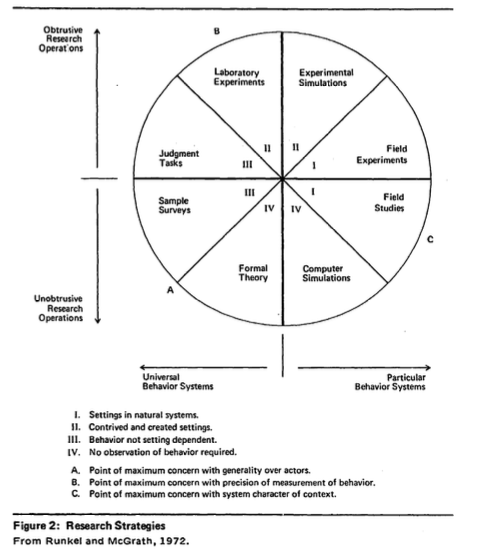
McGrath, Joseph E. (1981) Dilemmatics: The Study of Research Choices and Dilemmas, American Behavioral Scientist, 25, 2, 179-210
Simsek, Z., Heavey, C., Fox, B. C., & Yu, T. 2022. Compelling Questions in Research. Journal of Management, 48(6), 1347-1365.
Tushman, M., & O’Reilly, C. (2007). Research and Relevance: Implications of Pasteur’s Quadrant for Doctoral Programs and Faculty Development. The Academy of Management Journal, 50, No. 4, 769-774.
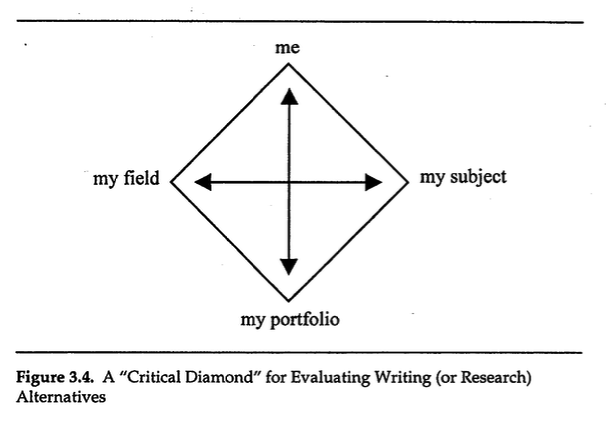
Huff (1999)
Writing for Scholarly Publication. SAGE. [Chs. 1, 3]
The critical questions ot answer are these:
Which conversations should I participate in?
Who are the important “conversants”?
What are these scholars talking about now?
What are the most interesting things I can add to the conversation? (p. 9)
Huff (1999)
Discussion Questions
Does the perspective of “conversation” resonate? How does this relate to academic work progressing iteratively rather than linearly?
How might you use this research diamond to inform your research question for this class?
McGrath (1981)
Dilemmatics: The Study of Research Choices and Dilemmas, American Behavioral Scientist, 25, 2, 179-210.
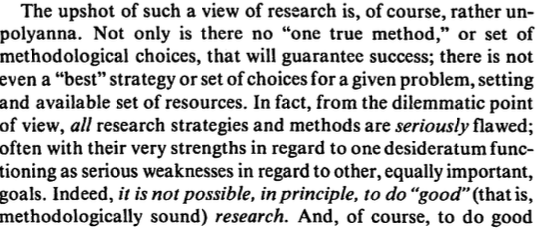
McGrath (1981)
Discussion Questions
Which quadrant feels most comfortable to you? Why?
What might you gain by combining multiple elements in a given study?
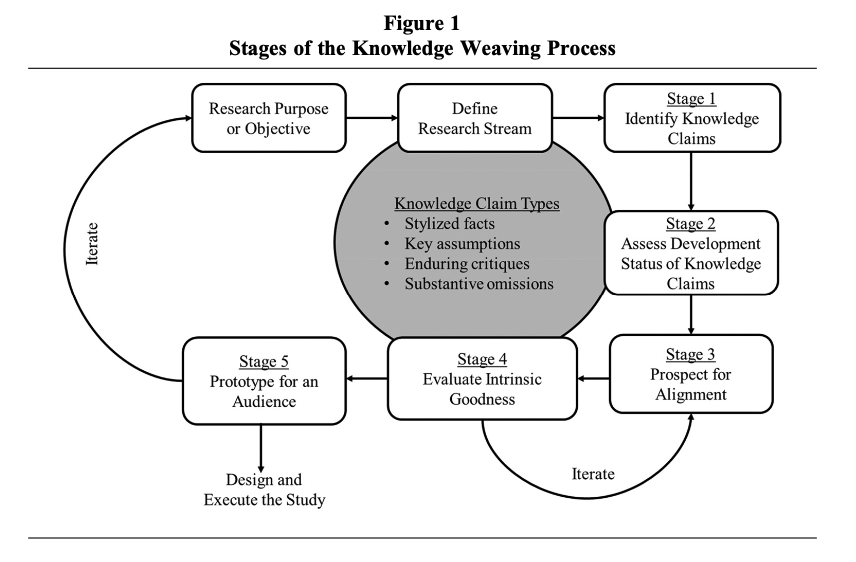
Simsek et al. (2022)
Compelling Questions in Research: Seeing What Everybody Has Seen and Thinking What Nobody Has Thought. Journal of Management, 48(6), 1347-1365.
We use knowledge weaving as a metaphor for achieving that alignment: combining the warp of distinct knowledge claims (i.e., what content is significant) with the weft of their developmental status (i.e., how to advance that content). Without both ingredients, the researcher risks shoehorning a question into the focal literature without substance. (p. 2)
Simsek et al. (2022)
Discussion Questions
Does this editorial provide a feasible pathway towards asking a compelling research question (asking for a friend)?
How can a dual focus on knowledge claim type and developmental status help to position your study within the extant scholarly conversation?
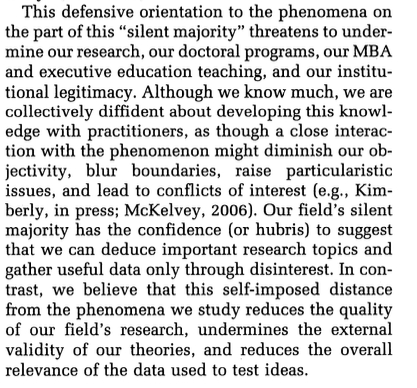
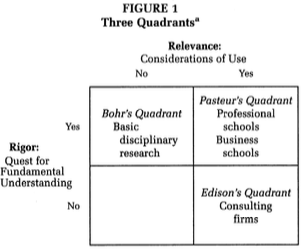
Tushman and O’Reilly (2007)
Research and Relevance: Implications of Pasteur’s Quadrant for Doctoral Programs and Faculty Development. The Academy of Management Journal, 50, No. 4, 769-774.
Tushman and O’Reilly (2007)
Discussion Questions
Based on what you have seen so far, how is your field doing in terms of operating in Pasteur’s quadrant?
What are the impediments to operating here and how might you overcome them?
Break

Lecture - Positions
Defining a landscape for research questions
Dimensions we have discussed today:
To what end? Rigor (understanding) and relevance (use)
By doing what? Precision, generalizability, and realism
With whom? What matters to you v. what matters to others
Means of advance? Types of knowledge claims and their level of development
Defining a landscape for research questions
How might they be correlated with each other?
Rigor and relevance:
Orthogonal (r = 0?)
In opposition (r = -1?)
Precision, generalizability, and realism:
- How do each map onto rigor and relevance?
Defining your place on that landscape
What matters to you v. what matters to others
What dimensions does your audience care about?
Which do you care about and why?
What implications does this have for topic selection? Outlet selection?
A potential missing piece: Novelty?
Defining your place on that landscape
Types of knowledge claims and their level of development
How do different combinations of knowledge claims and development status fit on the research landscape?
Stable stylized facts: High in relevance, perhaps “old news” to scholars (Edison’s quadrant?)
Unstable key assumptions: An opportunity to conduct basic research to build a new basis of understanding?
How might your choice of knowledge claims define you as a scholar?
Thinking about Thinking
Some useful types of thinking when engaging in the research process:
Skeptical thinking
Bayesian thinking
Strategic thinking
First principles thinking
Skeptical thinking
“Science depends on organized skepticism, that is, on continual, methodical doubting. Few of us doubt our own conclusions, so science embraces its skeptical approach by rewarding those who doubt someone else’s.” ― Neil deGrasse Tyson, Origins: Fourteen Billion Years of Cosmic Evolution
Skeptical thinking

Bayesian thinking
Implicit in the earlier discussions is our degree of belief.
Nosek and Errington talk about how replication increases or decreases our degree of belief.
Popper uses the asymmetry of verification to achieve binary outcome of disconfirmed evidence.
But couldn’t we be more subtle in our treatment of beliefs?
Indeed, we can through the application of Bayesian logic and Bayes’ Rule.
I will not be teaching you the statistical methods that follow from this, but you can find them.
Bayesian thinking

Strategic thinking
Finally, it helps to be strategic when thinking about designing and evaluating research. By this I mean thinking that embraces three characteristics:
Rigor
Complexity
Ambiguity
Strategic thinking
Rigor
Comprehensive – focusing attention on both the forest (a research program) and the trees (discrete methods or studies)
Adaptive – balancing multiple goals and knowing what progress can be made against one or more of them simultaneously (McGrath’s Trilemma)
Inferential – moving from what is known to what can be reasonably inferred (judicious use of multiple reasoning modes)
Strategic thinking
Complexity
Dynamics – accounting for first and second order effects that are material across actors, choices, and time (rigor)
Allocentricity – outcomes often jointly determined by internal and external factors, often other parties or agents
Strategic thinking
Ambiguity
Unstable – non-linear shifts across time and situations may limit generalizability and heighten the role of context (thinking about whether findings will maintain relevance)
Unforeseeable – many research projects are a full reinforcement learning problem, learning while doing is necessary to reveal the evolving state of the world
Strategic thinking
First principles thinking
A first principle is a basic assumption that cannot be deduced any further. Over two thousand years ago, Aristotle defined a first principle as “the first basis from which a thing is known.” First principles thinking is a fancy way of saying “think like a scientist.” Scientists don’t assume anything. They start with questions like, What are we absolutely sure is true? What has been proven? - James Clear
Preparation for Next Class
Next class - Workshop!
We will have a workshop session about four hours long. For the first two hours or so, students will make a three-minute presentation about their research topic/idea for their dissertation.
This can involve a few PowerPoint slides to help guide the discussion. It may be a broad topic or specific question; this will vary by student.
The balance of the workshop will be group work to discuss and advance those research questions; I will move from group to group to facilitate discussions.
Expectations
I am NOT looking for something super polished
I want to hear where you are at with your research question and I want your colleagues to know about it too
I’ll aim to reserve a minute or two for questions and comments after each presentation, but the substantive discussions will likely happen later in groups
Next class
Research III: Practices
Our first compare and contrast discussion will take place. Presenters, please reach out if you have questions or concerns!
Lange, D., & Pfarrer, M. D. (2017). Editors’ Comments: Sense and Structure—The Core Building Blocks of an AMR Article. Academy of Management Review, 42(3), 407-416.
Tobi, H., & Kampen, J. K. 2018. Research design: the methodology for interdisciplinary research framework. Qual Quant, 52(3), 1209-1225.
Aguinis, H. & Vandenberg, R. J. (2014). An ounce of prevention is worth a pound of cure: improving research quality before data collection.
Next class
Research III: Practices
- Compare / Contrast
Corley, K. G., & Gioia, D. A. (2011). Building Theory about Theory Building: What Constitutes a Theoretical Contribution. Academy of Management Review, 36(1), 12-32. https://doi.org/10.5465/amr.2009.0486
David A. Whetten, 1989. What constitutes a theoretical contribution? Academy of Management Review, 14: 490-495