Class 4 - Elements I: Theory and phenomena
Agenda
Skills corner (5 minutes)
Conceptual grounding (10 minutes)
Core paper discussion (40 minutes)
Break
Compare-contrast presentation (30 minutes)
Summative lecture on concepts (30 minutes)
- Theory and phenomena: Two sides of a coin
- Key thinking tool: Nomological networks
Skills corner
Strategic synthesis of scholarly articles
We read and take notes to help us synthesize the extant literature to either “get it” and / or demonstrate that it is insufficient to tackle the problem we want to solve
Scholarly articles are complex and often have two interrelated but distinct aspects: the theoretical model and the empirical model; it is important to capture elements of both
Inputs to strategic synthesis - Theory
What theories are being referenced explicitly or implicitly?
What is the skeleton of the argument? Have you seen it before or is it novel?
Qualitiatively, what elements of the argument are supported? With what evidence?
Are there any glaring oversights or omissions you notice?
What ‘key words’ are being used over and over again in the text?
Inputs to strategic synthesis - Empirics
What sample are they using? Does it have ‘face’ validity? If not, why not?
What measures are they using? Keep a log of ones that might be useful for you.
Are there important results for your topics of interest? If so, note them in detail somewhere for later reference.
How are the techniques and measures this paper used similar or different to others in the area?
Grounding
Two complementary organizing perspectives
Two sides to the same coin:
Theory: Focusing on generalizable mechanisms and the “why”
Phenomena: Focusing on real world outcomes and taking action
A missing ingredient to bind them together:
- Parameters: Critical differences between contexts
Readings for Today
Common Readings
Bacharach, S. B. (1989). Organizational Theories: Some Criteria for Evaluation. The Academy of Management Review, 14(4), 496-515. https://doi.org/10.2307/258555
Makadok, R., Burton, R., & Barney, J. (2018). A practical guide for making theory contributions in strategic management. Strategic Management Journal, 39(6), 1530-1545. https://doi.org/10.1002/smj.2789
Johns, G. 2006. The Essential Impact of Context on Organizational Behavior. The Academy of Management Review, 31, No. 2, 386-408.
A gradual shift in focus
Whereas the first three weeks entailed really broad discussions of the readings, I will start drawing out some specific items for us to talk about in the readings
This is not to suppress all of the other interesting parts of the papers; rather, it is because I will want to rely or build upon specific points in the weeks to come
Going forward, we may have one or two questions to warm up our discussion of the paper, and then we can dive into some key elements
Bacharach (1989)
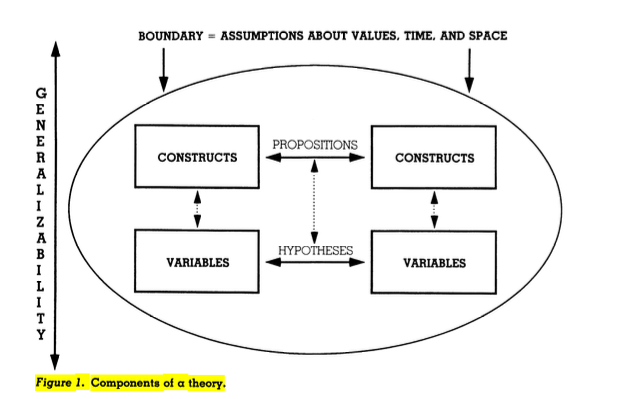
Bacharach (1989)
Discussion Questions
Does this paper tie together at we have seen to date?
What does this paper assume / take for granted?
Bacharach (1989)
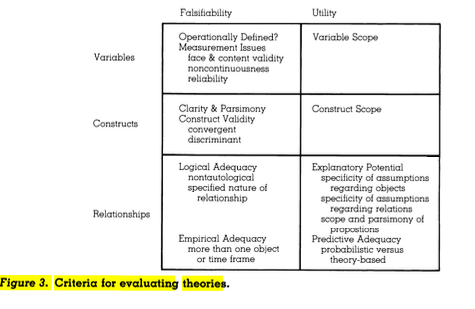
Bacharach (1989)
Key Points
Falsifiability, modes of inference (logical adequacy), explanatory potential - it’s all here!
Brings to the foreground the idea of a set of relationships between ideas
Emphasis placed on generalizability across contexts and explanatory potential
Johns (2006)
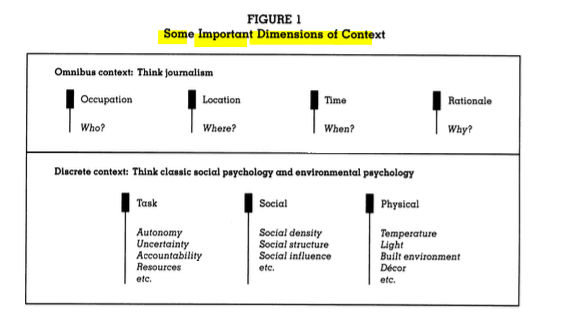
Johns (2006)
Discussion Questions
Did this paper resonate after what we have seen so far? Why?
How might ‘discrete’ context affect “hard science” systems, like physics?
Johns (2006)
The Many Faces of Context:
Salience of situational features
Situational strength
Cross-level effects
Bundle of stimuli
Discrete events
Shaper of meaning
Johns (2006)
Key Points
Context (where / when) can shape the relative importance of a theory compared to other effects
It can serve as a boundary of applicability or can condition theoretical effects
Makadok Burton and Barney (2018)
Rather than introducing radical new “grand theory” para- digms, most theory contributions in strategic management extend, clarify, or apply received theories in new and interesting ways. Here we offer a guide on how to make these kinds of contributions to theory. Theory usually begins with a research question, which can come from the phenomenon of interest, variations/limitations of existing theory, or intellectual creativity. Along with the question, there are a number of more craftsmanship-level aspects of a theory where contributions can be made […] (Abstract)
Makadok Burton and Barney (2018)
Discussion Questions
Did you find this useful?
Might this framework allow for an integration of theory and phenomena?
Makadok Burton and Barney (2018)
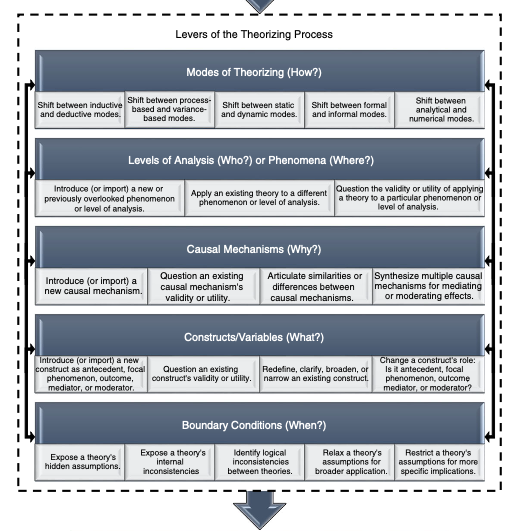
Makadok Burton and Barney (2018)
Key Points
There are many means by which theoretical contributions can be made
Contributing to theory means adding to our web of knowledge, you don’t need to spin the whole thing yourself
Phenomena can provide new lenses to see how a theory operates and old theories can be useful in explaining new phenomena
Break

Compare / Contrast Presentations
Sutton, R. I., & Staw, B. M. (1995). What Theory is Not. Administrative Science Quarterly, 40(3), 371. https://doi.org/10.2307/2393788
Hambrick, D. C. 2007. The field of management’s devotion to theory: Too much of a good thing? Academy of Management Journal, 50, 1346-1352.
Lecture - Theory and phenomena
Theory and phenomena: Two sides to a coin
Theory: foregrounding the parts and asking why
Phenomena: foregrounding the whole and successfully taking action
Motivating example from high school physics
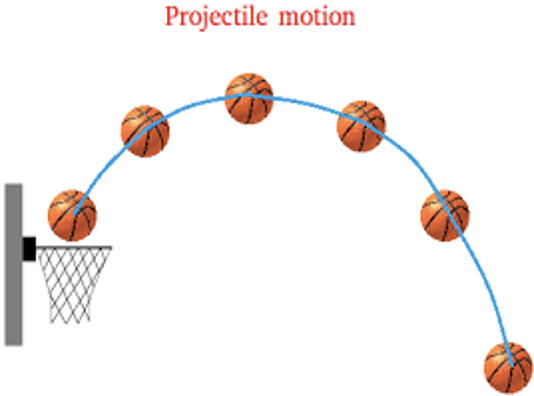
Phenomenon - Making a free throw
Let’s say we know exactly how much force we need to get the ball to travel from the free throw line to the hoop horizontally and our aim is dead straight.
But we don’t know how much we need to loft the ball to make it in the basket.
How do we solve for the height of the ball at any given time?
Goal: We want to successfully take an action - making a free throw
Theory - Newton’s second law
Newton says: The ball is being acted upon by the force of gravity, which imparts an acceleration.
\[a = g = -9.8 m/s^2\]
\[h(t) = h_0 + v_0t + (-9.8/2)t^2\] Will we get the answer right??
Goal: We want to understand - why does the ball move the way it does?
Aside - Turtles all the way down
Note this law is a mathematical expression between two quantities: the height of the ball and time. It doesn’t say where the expression is coming from or what is causing it.
We can say it is due to gravity since this relationship holds for any object on Earth, and thus a common gravitational field for the Earth is consistent with this explanation. Further, celestial bodies operate with similar mechanics.
But where does gravity come from?
Aside - Turtles all the way down
A well-known scientist (some say it was Bertrand Russell) once gave a public lecture on astronomy. He described how the earth orbits around the sun and how the sun, in turn, orbits around the centre of a vast collection of stars called our galaxy. At the end of the lecture, a little old lady at the back of the room got up and said: “What you have told us is rubbish. The world is really a flat plate supported on the back of a giant tortoise.” The scientist gave a superior smile before replying, “What is the tortoise standing on?” “You’re very clever, young man, very clever,” said the old lady. “But it’s turtles all the way down!” - Steven Hawking, A Brief History of Time
Context - Earth
Why is \(g = -9.8m/s^2 ?\)
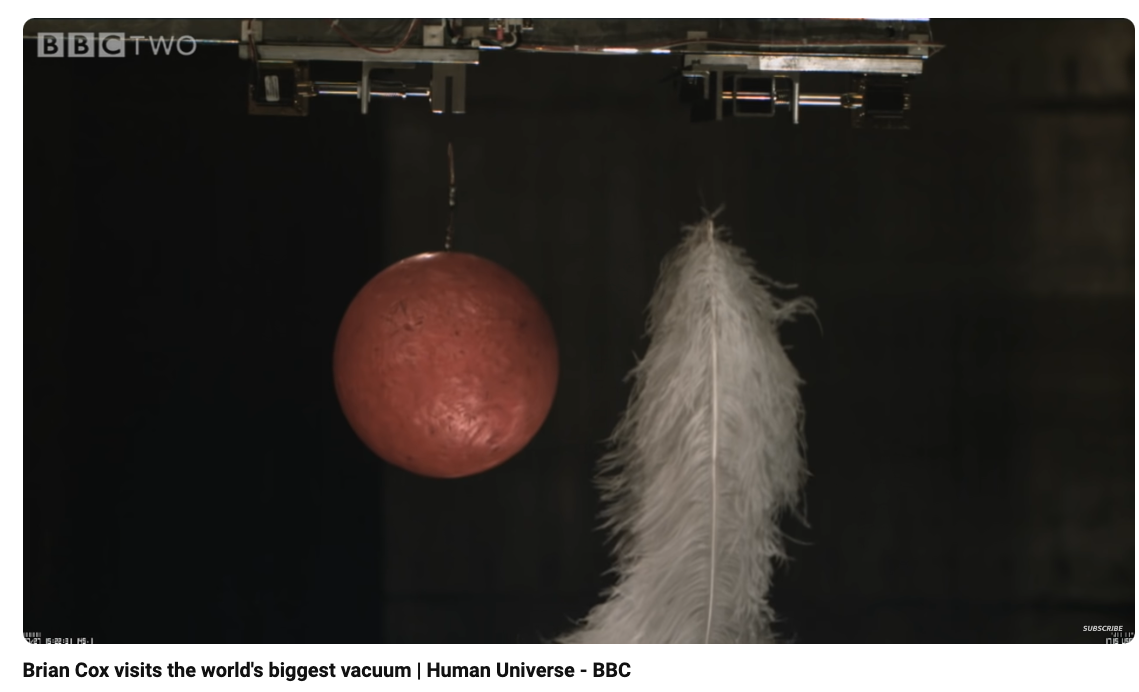
What about air resistance?
In both cases, the boundaries of the specific context are often captured by parameters
Context matters!
Aside: Theorizing
How would we arrive independently at the conclusion about the force of gravity?
\[a = g = -9.8 m/s^2\]
What observations would we need to make?
What data would we collect?
What would need to be true about the data generating process to get a solid answer?
Let’s generalize the example
The phenemonon is a problem we want to solve or something “real” we want to understand (score points)
We use theories to abstract away complexities and focus on core principles, which are often unobservable (the existance of gravity, and its effect)
But we need to be mindful of the context in which those theories are applied to pin down the values of relevant parameters (air resistance, gravitational force)
Summary
To oversimplify, here is my mental model:
Phenomena specify a universe of dependent variables and independent variables to define a particular context
Theories provide the “rules” for how a specific set of IVs and DVs interrelate across contexts
But we also need parameters to capture differences across contexts
Here is one way I try to keep both in mind as I read papers: http://briancfox.com/vfront/
Towards model building
Different foci, different nomological networks
Theory-focused: Construct / relationship / proposition centric
Phenomenon-focused: Variable / prediction / hypothesis centric
Nomological networks
Key Thinking Tool: Nomological networks
Scientifically speaking, to “make clear what something is” means to set forth the laws in which it occurs. We shall refer to the interlocking system of laws which constitute a theory as a nomological network. - (Cronbach and Meehl (1955), p. 290)
Key Thinking Tool: Nomological networks
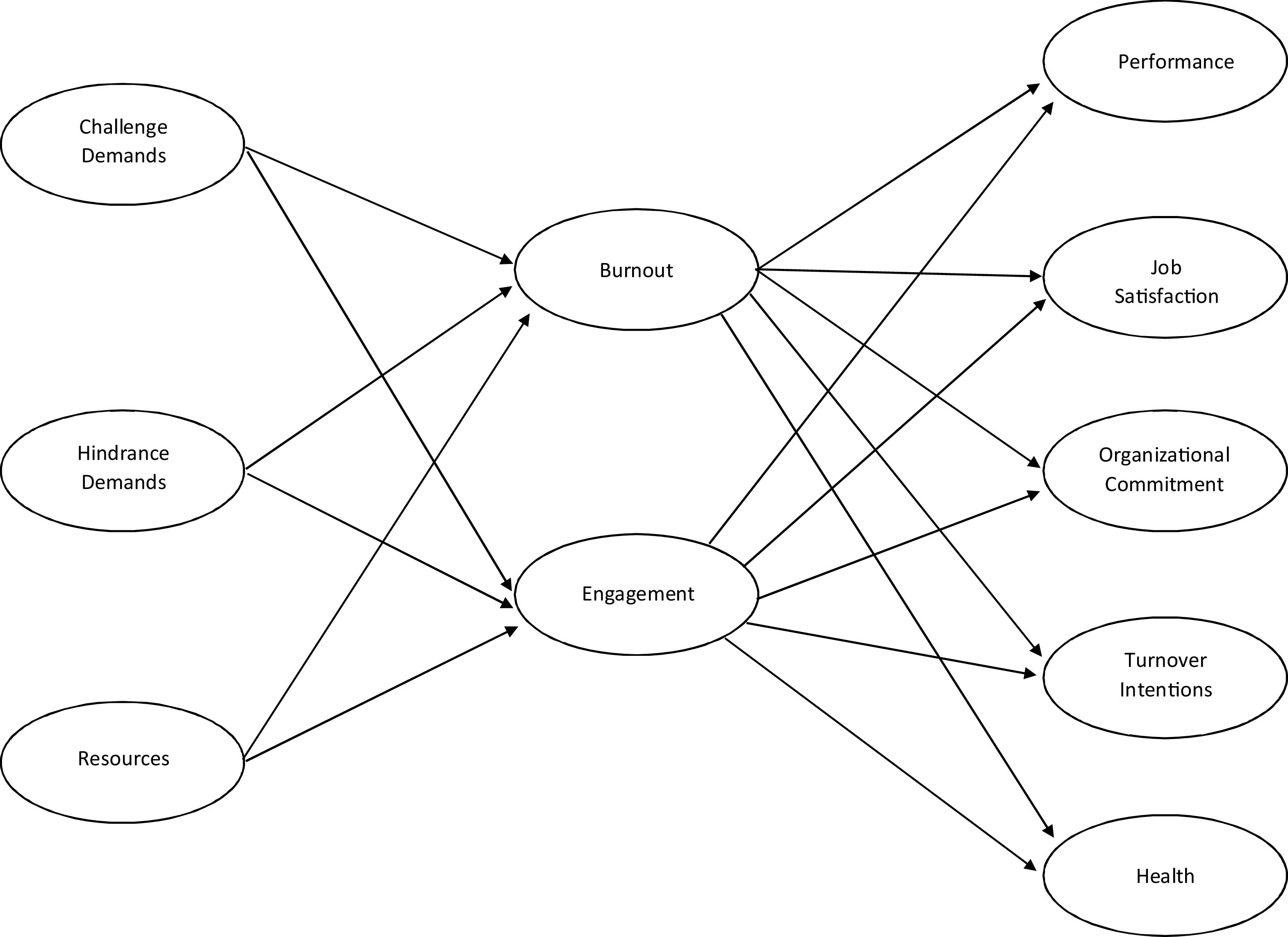
Theory-focused models
Objective: Make correct predictions across as many cases as possible (assuming other details rendered negligible)
How: Build out the nomological network of the theory
Connecting more and more variables and hypotheses across phenomena to a core set of constructs, relationships, propositions
Expanding upon the common core of constructs (who/what)
Determining the mechanisms of actions and underlying causes (how, why)
Identifying and pushing on the boundaries of applicability (where, when)
Phenomenon-focused models
Objective: Make the best prediction for a specific case
How: Build out the nomological network of the phenemonenon (this is not how it is thought of in the literature)
Connecting more and more constructs and relationships across theories to explain a core set of variables
Identifying the key variables at play and the context/parameters that matter (who/what)
Determining how theories comport and conflict in the specific situation (how, why)
Taking advantage of a specific bounds of a context to pin down predictions with precision (where, when)
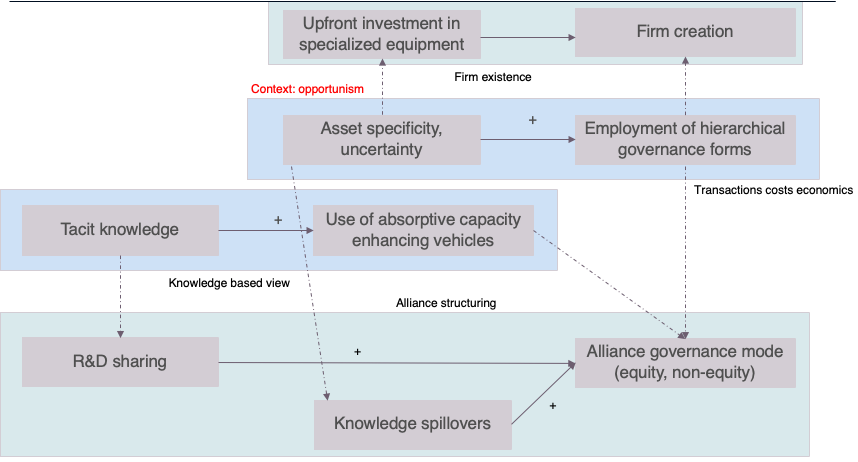
Comparing theoretical and phenomological nomological networks
Preparation for next class
Next class
Concept check 1 will available this evening - please complete it before next class.
Next class
Elements II: Models and hypotheses
Harris, J. D., Johnson, S. G., & Souder, D. 2013. Model-Theoretic Knowledge Accumulation: The Case of Agency Theory and Incentive Alignment. Academy of Management Review, 38(3), 442-454.
Chamberlin, T. C. (1965). The Method of Multiple Working Hypotheses. Science, 148(3671), 754-759. https://doi.org/10.1126/science.148.3671.754
Pearl, J. 2010. 3. The Foundations of Causal Inference. Sociological Methodology, 40(1), 75-149.
Next class
Elements II: Models and hypotheses
- Compare / Contrast
Adner, R., Pólos, L., Ryall, M., & Sorenson, O. 2009. The Case for Formal Theory. Academy of Management Review, 34(2), 201-208.
Miller, K. D. & Tsang, E. W. K. 2011. Testing management theories: Critical realist philosophy and research methods. Strategic Management Journal, 32(2): 139-158.