Class 6 - Elements III: Constructs and variables
Agenda
Skills corner: DAGs x formal theory (15 minutes)
Conceptual grounding (5 minutes)
Core paper discussion (40 minutes)
Break
Compare-contrast presentation (30 minutes)
Summative lecture (20 minutes)
- Key thinking tool: Validity assessments
Skills corner
Switching gears
Up until now, we have been focused on reading and digesting information from articles
Now, we turn to developing your supporting skills for integrating theoretical and empirical models, analyzing and interpreting data, discerning what methods and inferences are appropriate
Key Thinking Tool: DAGs
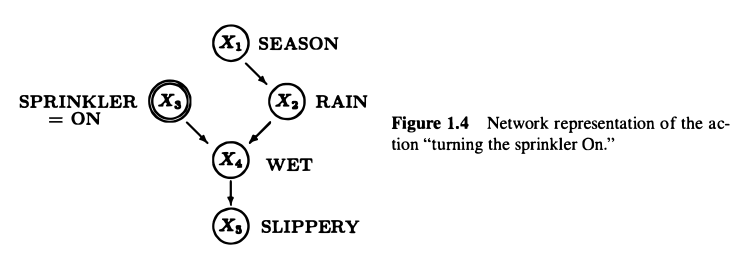
Directed acyclic graph
has nodes (constructs) and edges (relationships)
there are no loops
the relationships have a direction of influence (correlations are bidirectional)
Key Thinking Tool: DAGs
Why DAGs?
They provide a visual tool to determine if the claims we make can possibly be causal (Pearl 2010)
They provide a scaffold upon which future researchers can more easily build
And at a minimum, they force us to write out our model explicitly in terms of constructs and relationships
Key Thinking Tool: Formal theory
Why formal theory?
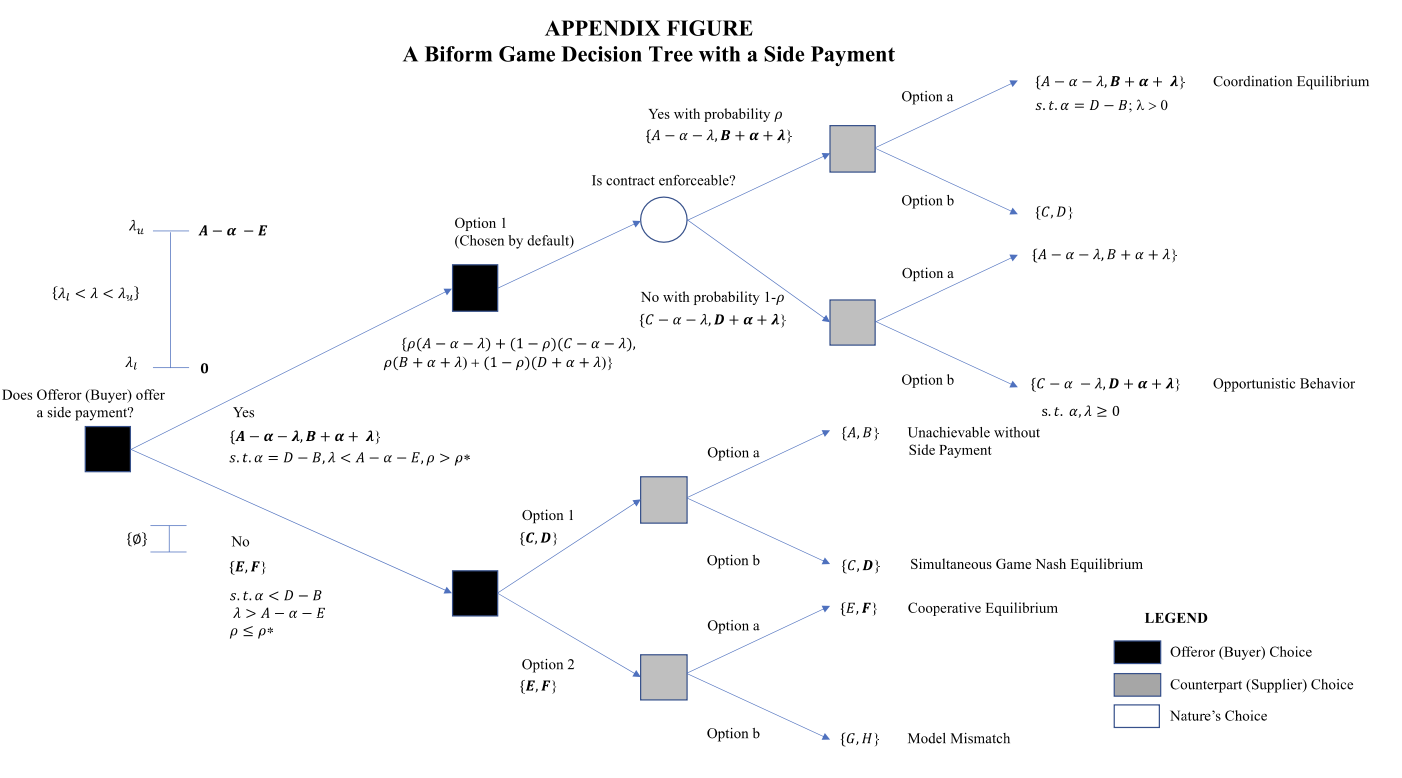
precision and transparency
logical consistency, and
an ability to identify unanticipated implications (Adner et al. 2009, 202)
Integrating DAGs with formal theory
DAGs can make clear how a model fits within a larger set of nomological networks, be they theoretical or phenemenonological
Formal theorizing provides the tools to consider more complex relationships and nth-order effects than verbal theorizing readily affords, which tends to capture first-order, linear1 chains of logic
Note that the final paper may not showcase this work, but it can be the scaffolding to facilitate deep thinking
Grounding
Making things real
Constructs: Bounding ideas to give them form
Variables: (Imperfectly) reifying constructs to make them observable
Readings for Today
Common Readings
Suddaby, R. (2010). Editor’s Comments: Construct Clarity in Theories of Management and Organization. Academy of Management Review, 35(3), 346-357. https://doi.org/10.5465/amr.35.3.zok346
Larsen, K, Bong, CH. 2016. A tool for addressing construct identity in literature reviews and meta-analyses. MIS Quarterly 40, No. 3: 529-552.
Bagozzi, R. P., Yi, Y., & Phillips, L. W. (1991). Assessing Construct Validity in Organizational Research. Administrative Science Quarterly, 36, No. 3, 421-458. https://doi.org/10.2307/2393203
Suddaby (2010)
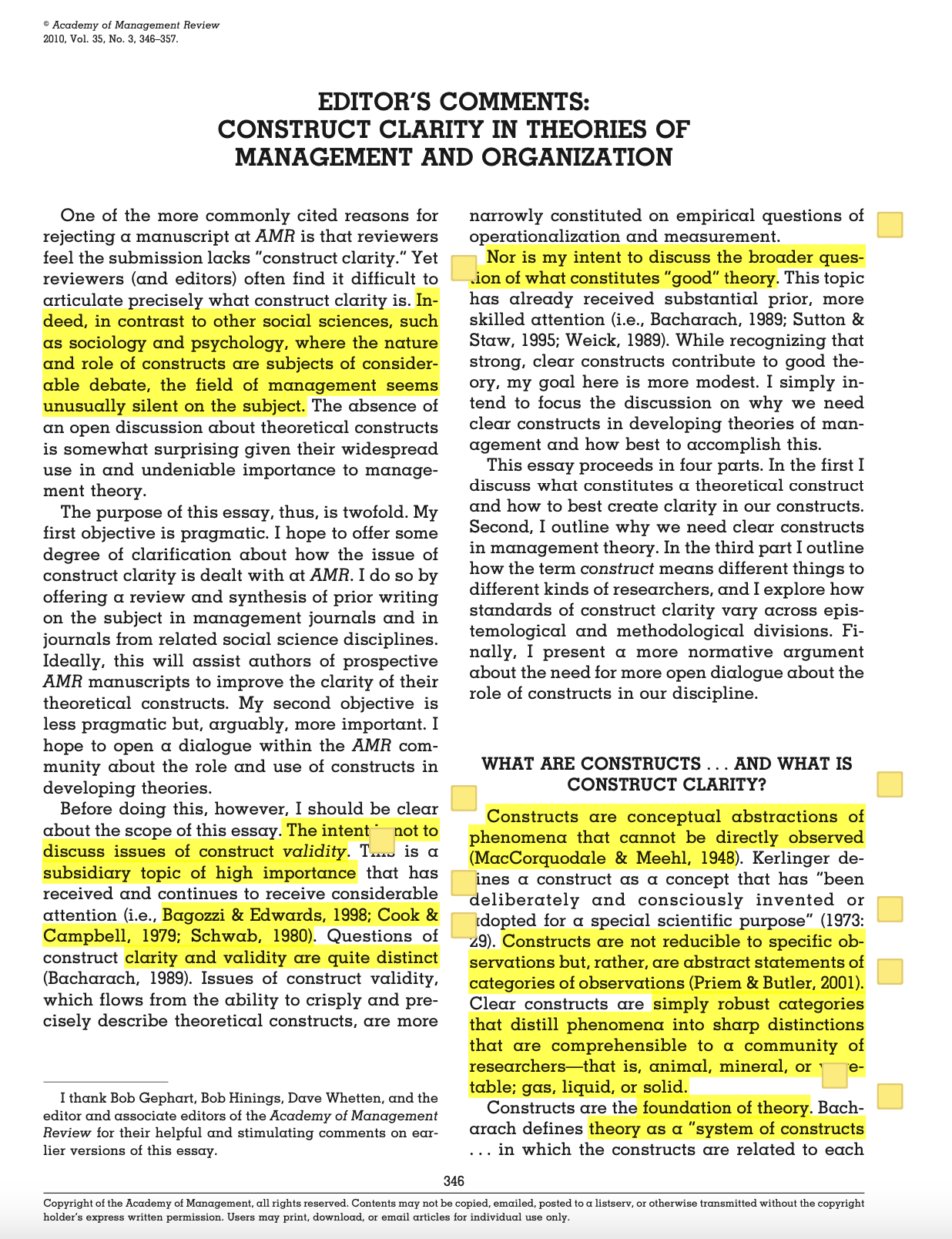
Clear constructs are simply robust categories that distill phenomena into sharp distinctions that are comprehensible to a community of researchers — that is, animal, mineral, or vegetable; gas, liquid, or solid. (Suddaby 2010, 346)
Suddaby (2010)
Discussion Questions
Do you agree with Suddaby’s definition of a construct?
Can you provide an example of a clear construct from your readings? Why is it so?
How about a construct that is completely unclear? How could we make it better?
Suddaby (2010)
The essence of construct clarity comprises four basic elements (Suddaby 2010, 347).
Definitions: skillful use of language to persuasively create precise and parsimonious categorical distinctions
Scope conditions: circumstances under which a construct will or will not apply
Semantic relationships: how does the construct relate to others
Coherence: consistency with relation to overall theoretical argument
Larsen and Bong (2016)
Larsen and Bong (2016)
Discussion Questions
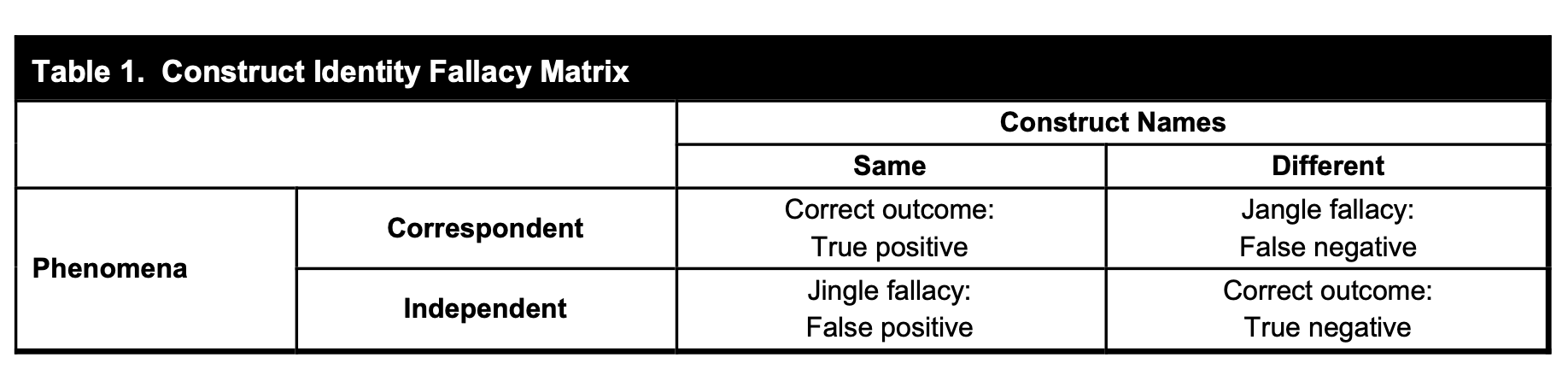
What are the jingle / jangle fallacies?
Have you seen something like this in your work or research to date?
Larsen and Bong (2016)
Key points
There are tools to help you find and locate constructs
You can help future research by taking the time to determine whether you need to create a new construct to make your point
Aside: This paper also is a nice example of weaving quantitative analysis into a literature review by drawing on the sensitivity/specificity framework (TP/FP, TN/FN)
Bagozzi Yi and Phillips (1991)
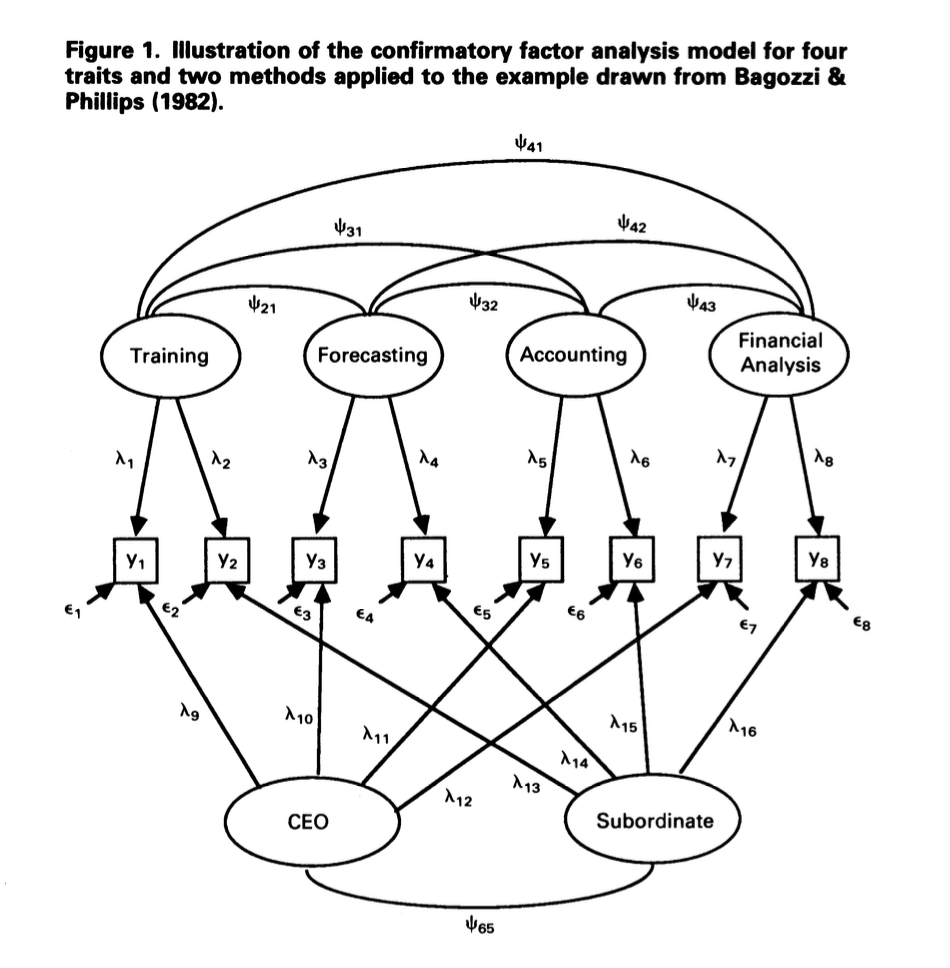
Bagozzi Yi and Phillips (1991)
Discussion questions
I know this was dense, what did you get out of this paper?
Based on this paper, how can we demonstrate construct validity?
Is this logic of all this just circular?
Bagozzi Yi and Phillips (1991)
Key Points
Psychometric theory is predicated on a linkage between constructs and variables, different methods have different assumptions about their relationship
Variables have multiple sources of relevant variation - construct/trait, method/measurement tool, and idiosyncratic error
There are many ways to assess construct validity, each with its benefits and drawbacks
Break

Compare / Contrast Presentations
Schaffer, J. A., DeGeest, D., & Li, A. 2016. Tackling the problem of construct proliferation: A guide to assessing discriminant validity of conceptually related constructs. Organizational Research Methods, 19: 80- 110.
Law, K. S., Wong, C.-S., & Mobley, W. H. (1998). Toward a Taxonomy of Multidimensional Constructs. The Academy of Management Review, 23(4), 741. https://doi.org/10.2307/259060
Validity assessments
Moving from a summation to tutorial focus
Going forward, our “lecture” period will move away from tying the various papers together and rather using them as a gateway for us to talk about different tools and techniques for performing analyses
Types of validity: Construct-centric
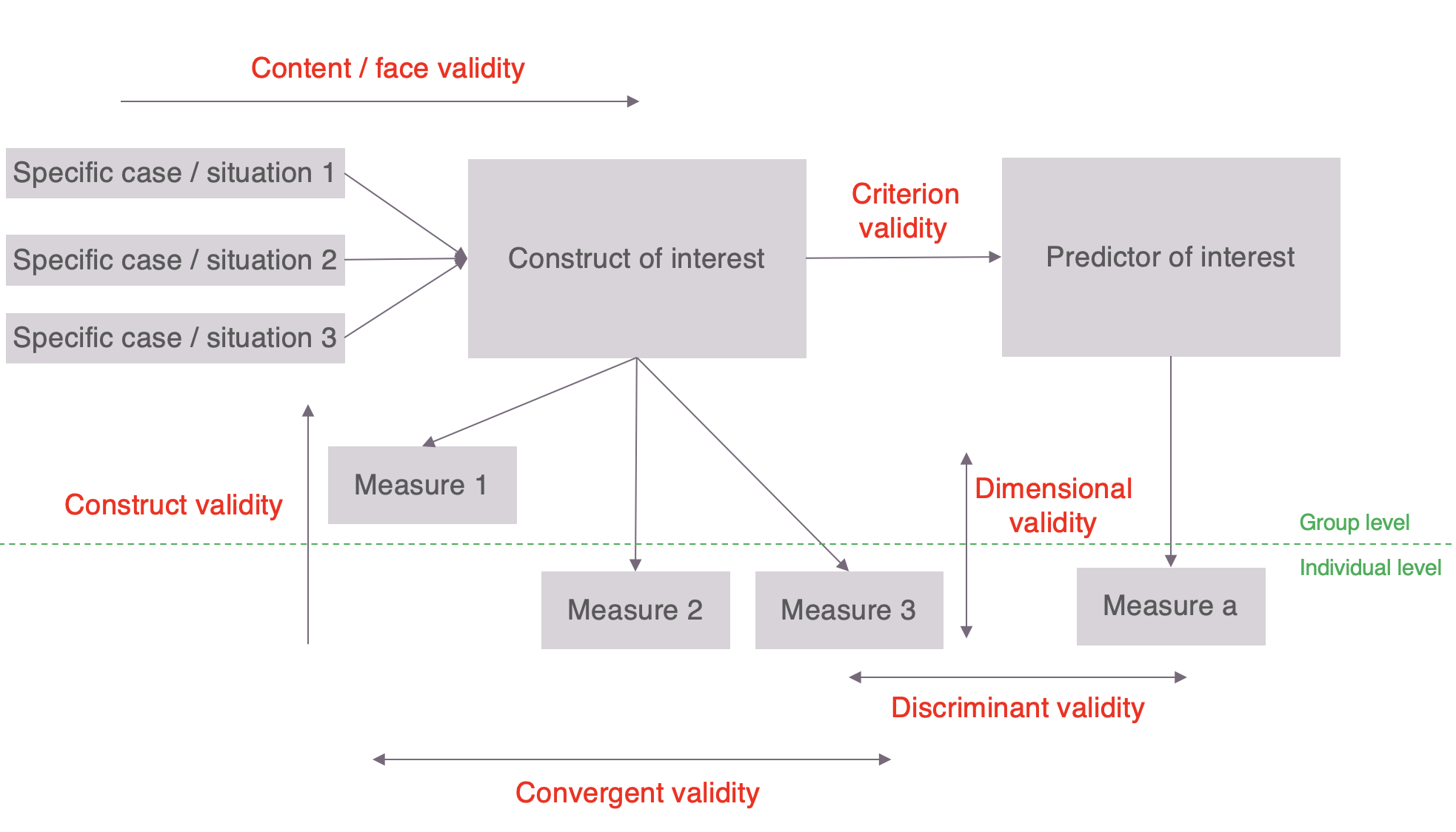
Criterion validity: The extent to which an operationalization of a construct relates to, or predicts, a theoretically related behaviour or outcome (Cronbach and Meehl 1955, 282) (i.e., semantic relationships and coherence)
Content or “Face” validity: The extent to which the construct is comprises a sample of a universe in which the investigator is interested (does it look like a duck and quack like a duck?) (i.e., defintion and scope conditions) (Cronbach and Meehl 1955)
Types of validity: Construct-variable interface
“Dimensional” validity: The dimension of the constructs and the measures are appropriately specified with due attention paid in operationalization (Law, Wong, and Mobley 1998)
Construct validity: The extent to which an operationalization measures the concept it is supposed to measure (Bagozzi, Yi, and Phillips 1991, 421)
Types of validity: Variable-centric
Convergent validity: The degree to which multiple attempts to measure the same concept are in agreement (Bagozzi, Yi, and Phillips 1991, 425)
Discriminant validity: The extent to which measures of theoretically distinct constructs are unrelated empirically to one another (Campbell & Fiske, 1959) (Shaffer, DeGeest, and Li 2016)
One possible visualization of validity elements
Common tools for assessing validity
Cronbach’s alpha (convergent validity)
- there are many other “congeneric” tests
Multi-trait, multi-method matrices (MTMM) (convergent + divergent)
- this is the canonical approach but relatively inflexible
Confirmatory factor analyses (convergent + divergent)
- As (Bagozzi, Yi, and Phillips 1991) notes, there are many versions of this
A whole bevy of tools for multi-level constructs
- Some examples include ICC, Rwg, among others
Where does qualitative work fit into all of this?
One interpretation is that qualitative work helps to ascertain the bounds of a construct of interest are and the face validity of any constructs that are subjected to quantitative analyses
Where does actual data fit into all of this?
Where are our measures coming from?
How might data availability enable or constrain the our ability to successfully explore the various elements of the above diagram?
Preparation for next class
Next class
Elements IV: Data and measures
Stevens, S. S. 1946. On the Theory of Scales of Measurement. Science, New Series, 103, No. 2684, 677-680.
Bedian, A. G. 2014. “More Than Meets the Eye”: A Guide to Interpreting the Descriptive Statistics and Correlation Matrices Reported in Management Research. Academy of Management Learning & Education, 13, No. 1, 121-135.
Heggestad, E. D., Scheaf, D. J., Banks, G. C., Monroe Hausfeld, M., Tonidandel, S., & Williams, E. B. (2019). Scale Adaptation in Organizational Science Research: A Review and Best-Practice Recommendations. Journal of Management, 45(6), 2596-2627.
Next class
Elements IV: Data and measures
- Compare / Contrast
Combs, J. G. 2010. Big samples and small effects: Let’s not trade relevance and rigor for power. Academy of Management Journal, 53(1): 9-13.
Simsek, Z., Vaara, E., Parachuri, S., Nadkarni, S., & Shaw, J. D. 2019. New ways of seeing big data. Academy of Management Journal, 62: 971-978.
Preparation for next workshop
During our second in-person meeting, we will have another workshop session. Students will make a five-minute presentation about the draft model that they will examine for their dissertation work that builds upon their research topic/idea. Again, this can involve a few PowerPoint slides to help guide the discussion. This will be graded by the presence or absence of your preparation for this session. The balance of the workshop will be group work to discuss and advance those research questions, where I will move from group to group to facilitate discussions.
References
References
Footnotes
Note that linearity is not as technically constraining as it may seem. Linearity means that a tested function must be linear with respect to its parameters, not its arguments. Thus, \(y = \beta x^2\) is permissable but \(y = \beta^2x\) is not. The issue is not so much a technical issue but straight-line thinking↩︎