Class 9 - Techniques II - Moderation
Agenda
The logic of moderation: what, why, when, how (30 minutes)
Application paper discussion (30 minutes)
Break
Replication presentation (15 minutes)
Skills corner - Class walkthrough in R (25 minutes)
General discussion (15 minutes)
Preamble
While I really dove into the weeds last class, I will be keeping it higher level for remainder of the “techniques” classes
The logic of moderation
What is moderation?
In general terms, a moderator is any variable that affects the association between two or more other variables; moderation is the effect the moderator has on this association. Dawson (2014)
What is moderation?
Nomological network view:
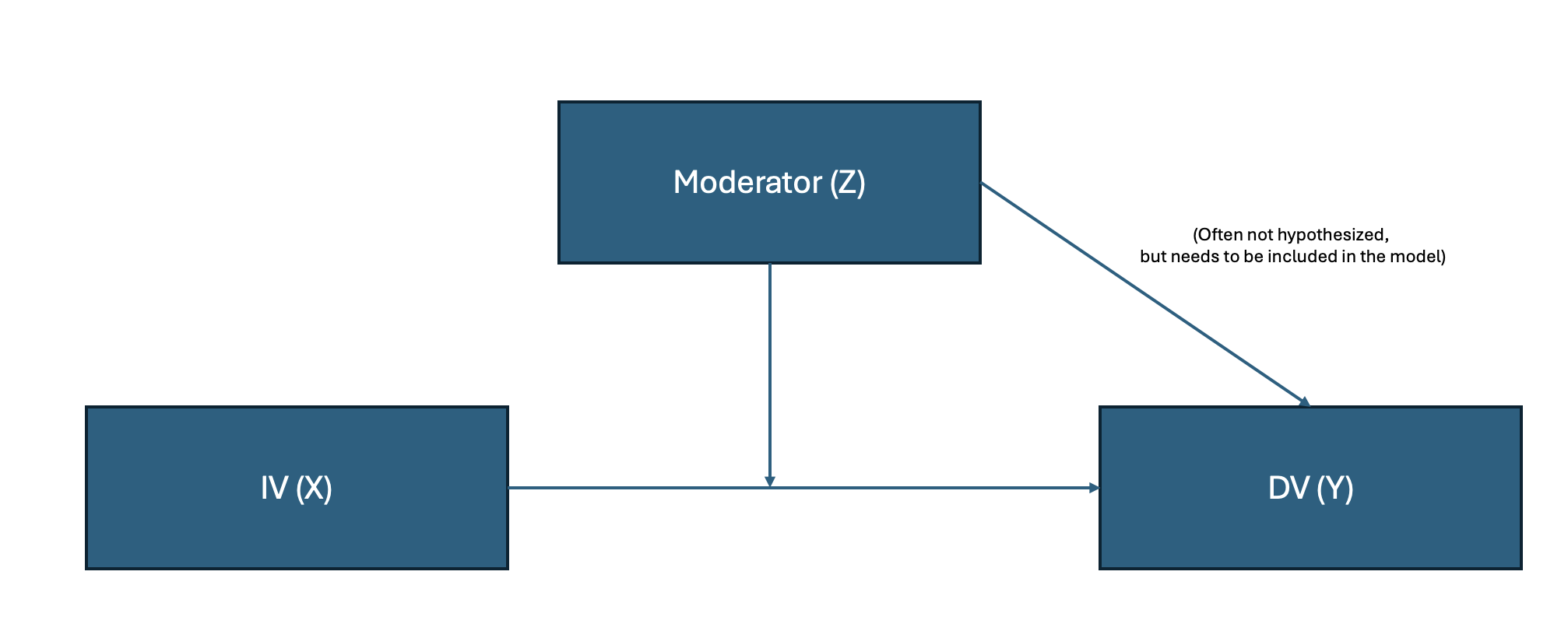
Regression model view:
\(Y = \beta_0 + \beta_1X + \beta_2Z+ \beta_3XZ + \epsilon\)
Why moderation?
Solves a theoretical problem
- Management research, like many other disciplines, is replete with theories suggesting that the relationship between two variables is dependent on a third variable (Dawson 2014)
New tools are available for modeling
Recent developments have proven to be more flexible and appropriate for multilevel data arrangements. Most notably, random coefficients modeling (RCM) has seemingly become the analysis of choice (Hitt et al. 2007)
And while moderation in linear regression is straightforward, it is not so simple for non-linear models like logit or probit where marginal effects are non-constant
When is moderation appropriate?
Complementarities and substitution effects: \(y = \beta_1PB + \beta_2Jelly + \beta_3PB*Jelly\)
Contextual differences: \(y = \beta_1x + \beta_2D_{country} + \beta_3 xD_{country}\)
Structural breaks: \(y = \beta_1t + \beta_2\delta + \beta_3\delta t\)
Difference-in-differences: \(y = \beta_1\Delta + \beta_2\delta + \beta_3\Delta\delta\)
Curvilinear effects: \(y = \beta_1x + \beta_2x^2\) = \(y = (\beta_1+\beta_2x)x\)
Heterogeneous effects: \(y_{ij} = \beta_0 + \beta_{1j}x + \epsilon_{ij}\); \(\beta_{1j} = \gamma_{10} + \nu_j\)
Performing a moderation analysis
How do you perform a (basic) moderation analysis?
Clearly make your prediction as a hypothesis.
(Optional). Center and scale variables
Run regression with “main effects” only (including the moderator!)
Include interaction effects
Perform statistical inference (t-tests, \(\Delta R^2\), F-tests)
Plot interaction and assess marginal effects
Run supplemental tests (e.g., tests of curvature (Haans, Pieters, and He 2016), simple slopes (Dawson 2014), regions of significance)
Deep dive: Clearly make your prediction as a hypothesis
It is critical when making an argument for moderation that you specify what you mean. Is it:
A pre-existing (positive / negative) main effect will become (stronger / weaker) in the presence of the moderator?
An (existing/null) effect will become (absent/present) in the presence of the moderator?
The moderator has such an influence that it will flip the sign of the effect, depending on its level?
Which is the main effect and what is the moderator?
Will the moderator have an indepedent influence (i.e., a mean shift)?
Illustrating an moderation: Interaction plots
Here is an example of an amplifying interaction, the moderator has a independent effect (shifts the curve up) and increases the slope of the main effect

Illustrating an moderation: Interaction plots
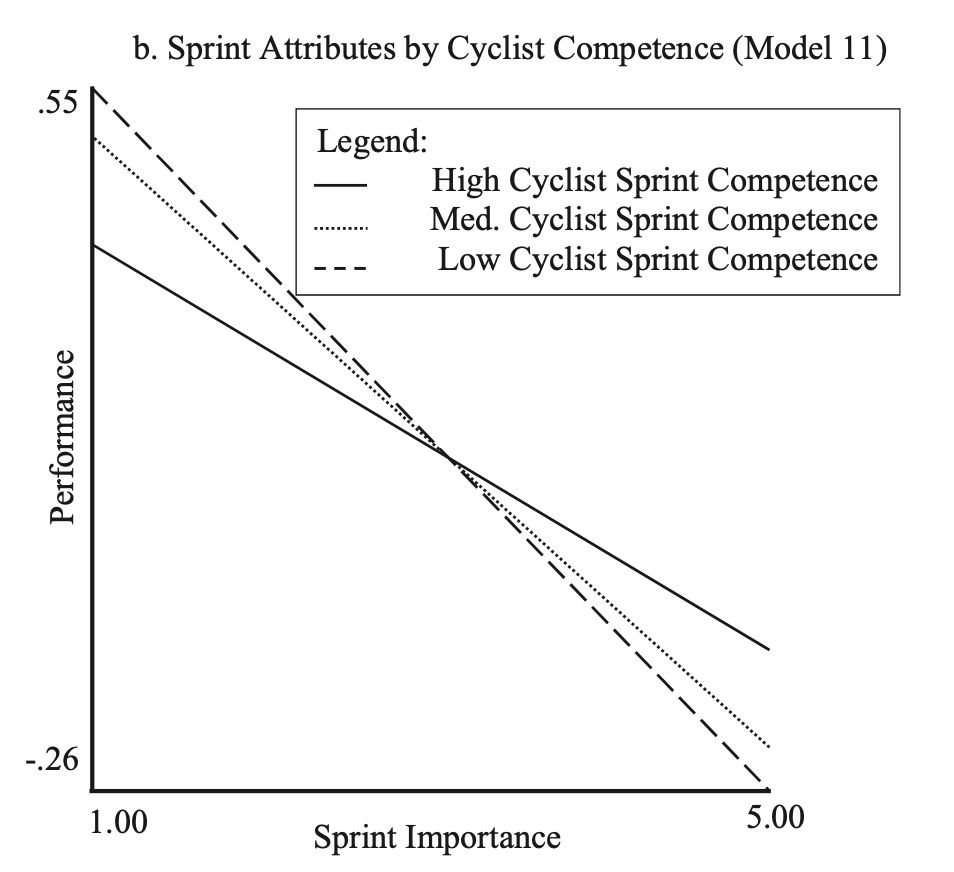
Here is an example of an “cross-over” interaction, the moderator has no independent effect (curves are centered at a common point) but the slope changes
The “extreme case” of a crossover interaction is when the X variable has no main effect across the whole population, but has a positive or negative effect depending on the level of the moderator
Things can get crazy! Three-way interactions
Yes, you can test them (although statistical power becomes an issue).
But to be justified, you need to explain all of the various ways three variables can interact.
Let’s keep it simple and say each variable is binary (0/1). That is already \(2^3\) possible combinations to consider and have a story for.
Statistical v. substantive meaning
Statistical meaning - the coefficient is significant
Substantive meaning - how is the pattern of results differs with or without the interaction included in the model
“Generalizing” moderation: HLM / RCM
I have given you two readings (Hitt et al. (2007) and Wolfson and Mathieu (2018)) to help you dip your toes into the waters of hierarchical linear modeling (HLM) / a.k.a. random coefficients modeling (RCM)
This can be viewed as a “generalization” of moderation, where slope coefficients (betas) and intercepts can not only be dependent on a third variable but may have their own random distribution
This technique allows you to naturally model nested settings (Hitt et al. 2007), but gets complicated quickly
Alternative analyses
Subsample analyses
Qualitative comparative analysis (QCA)
Orthogonal polynomial regression
Contingency tables (cross-tabs)
Applications
Application readings
Let’s level-set people’s familiarity with these pieces.
Heavey, C., Simsek, Z., & Fox, B. C. 2015. Managerial Social Networks and Ambidexterity of SMEs: The Moderating Role of a Proactive Commitment to Innovation. Human Resource Management, 54(S1).
Wolfson, M. A., & Mathieu, J. E. 2018. Sprinting to the finish: Toward a theory of Human Capital Resource Complementarity. J Appl Psychol, 103(11), 1165-1180.
Heavey et al (2015)
What was this paper about?
What were the findings?
What was the method?
What makes sense? What was confusing?

Wolfson and Mathieu (2018)
What was this paper about?
What were the findings?
What was the method?
What makes sense? What was confusing?
Break

Replication Presentation
- Replication: Heavey, C., Simsek, Z., & Fox, B. C. 2015. Managerial Social Networks and Ambidexterity of SMEs: The Moderating Role of a Proactive Commitment to Innovation. Human Resource Management, 54(S1).
Class walkthrough in R
Preparation for next class
Next class
Techniques III: Mediation
Mathieu, J. E., & Taylor, S. R. 2006. Clarifying conditions and decision points for mediational type inferences in Organizational Behavior. Journal of Organizational Behavior, 27(8), 1031-1056.
Williams, L. J., Vandenberg, R. J., & Edwards, J. R. 2009. 12 Structural Equation Modeling in Management Research: A Guide for Improved Analysis. Academy of Management Annals, 3(1), 543-604.
Next class
Techniques III: Mediation
Applications:
Ling, Y., Simsek, Z., Lubatkin, M. H., & Veiga, J. F. 2008. Transformational Leadership’s Role in Promoting Corporate Entrepreneurship: Examining the CEO-TMT Interface. Academy of Management Journal, 51(3), 557-576.
Replication: Fox, B. C., Simsek, Z., & Heavey, C. 2022. Top Management Team Experiential Variety, Competitive Repertoires, and Firm Performance: Examining the Law of Requisite Variety in the 3D Printing Industry (1986–2017). Academy of Management Journal, 65(2), 545-576.